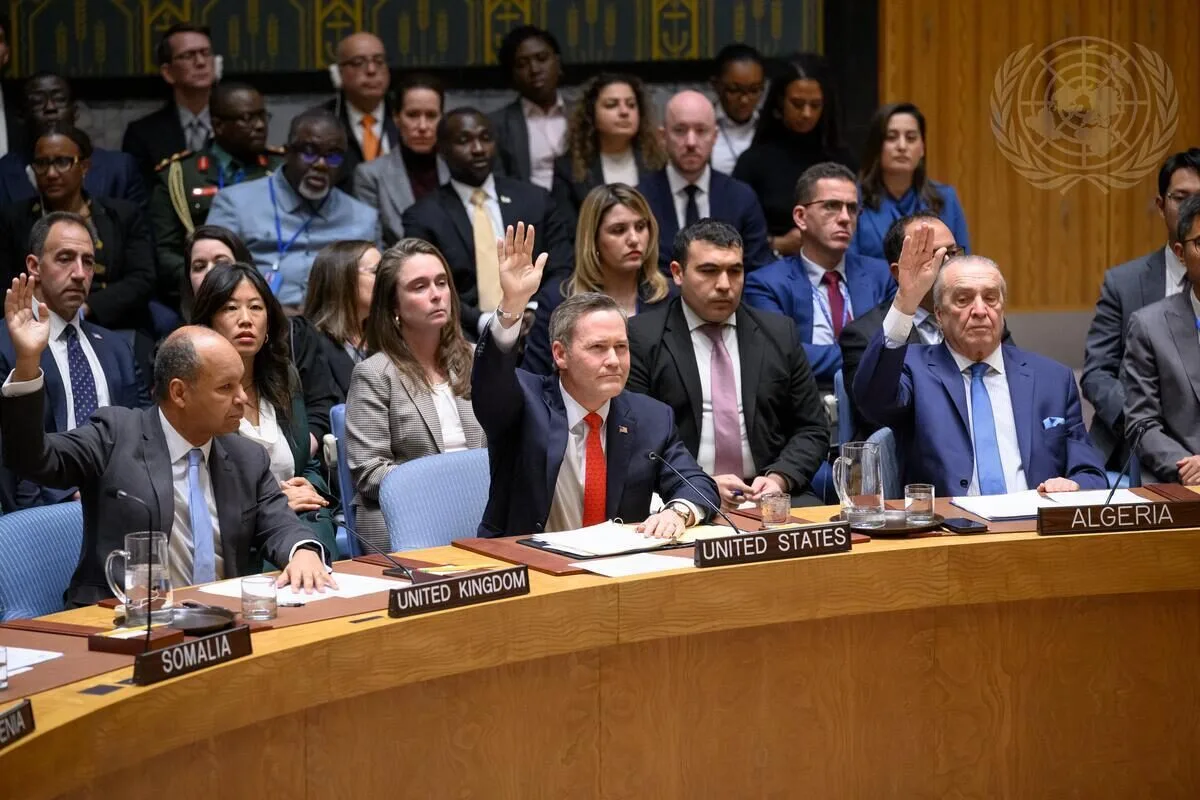
On Monday, November 17, the UN Security Council adopted resolution 2803 (2025) authorizing the creation of an “International Stabilization Force” and a “Board of Peace” aimed at addressing the critical security, humanitarian, and reconstruction needs in Gaza. The resolution affirms the importance of enabling humanitarian aid, maintaining a ceasefire, and the goal of working towards “a horizon for peaceful and prosperous coexistence.” However, QUNO notes with concern the resolution’s disregard for the consent or agency of Palestinians within the mechanisms proposed by the resolution. Furthermore, the resolution fails to establish clear mechanisms for transparency, accountability, and effective humanitarian aid and reconstruction. Both observers and UN member states have pointed out that the resolution’s unilateral approach could sideline the United Nations and risk repeating colonial actions and ideologies that lie at the heart of the conflict.
At its core, the Security Council resolution gives UN backing to the “Comprehensive Peace Plan,” also known as the “20-point plan,” proposed by US President Donald Trump earlier this year. The United States proposed the resolution and lobbied strenuously to push it through the Security Council on an expedited timeline. The resolution gives a green light to main tenets of the President’s plan, principally, the establishment of three entities: a “Board of Peace” that would temporarily oversee security, reconstruction, and aid efforts; a committee of apolitical Palestinian experts who would take on day-to-day administration of Gaza; and an “International Stabilization Force” (ISF), comprised of military personnel from various nations, charged with disarming armed groups in Gaza and maintaining security for residents and aid missions.
Concerns regarding this resolution stem from several sources. First and foremost, the resolution does not facilitate a meaningful role for Palestinians in shaping the political, financial, and logistical processes that would determine the reconstruction of their homeland. Contrary to longstanding UN practice, the resolution offers only weak acknowledgement of Palestinians’ international legal right to self-determination. While the resolution was officially supported by the Palestinian Authority (PA), a move that ultimately sealed its passage, observers note that the PA’s endorsement should not be taken to mean that the resolution, or the Trump plan, enjoy popular support of the Palestinian people. The resolution also concerningly leaves out any mention of the West Bank or East Jerusalem, critical regions for a wider solution to the ongoing crisis and the subjects of increasingly extreme land grabs, annexations, and attacks enabled by Israeli government entities.
Another chief concern from the resolution is the consistent lack of detail surrounding the “Board of Peace” and “International Stabilization Force.” In their statements, members of the Security Council stressed the need for further clarity on the composition of the Board of Peace, the exact role and duties of the International Stabilization Force, and clear timelines and benchmarks for Israeli withdrawal They also requested explicit criteria for success in reconstruction, security stabilization, and aid distribution. Without careful detail and planning, mechanisms under this plan risk ineffectiveness, failure, and allowing the resumption of full-scale violence.
Resolution 2803 passes up a meaningful diplomatic role for the United Nations and hands decision-making power in Gaza to those with the greatest military power and political influence, rather than the Palestinian people. The adoption of this resolution raises profound concerns for all those committed to the principles of nonviolence, restorative justice, and accountability. In New York, QUNO’s work focuses on strengthening the UN’s leadership for sustainable peace that centres the needs of people. We are deeply concerned that Resolution 2803 fails to outline measures that meet real human needs and address root causes of conflict. While QUNO hopes that recent positive developments will endure, including a continued official ceasefire and increased humanitarian aid, we worry that Resolution 2803 falls far short of what this moment in history requires.